
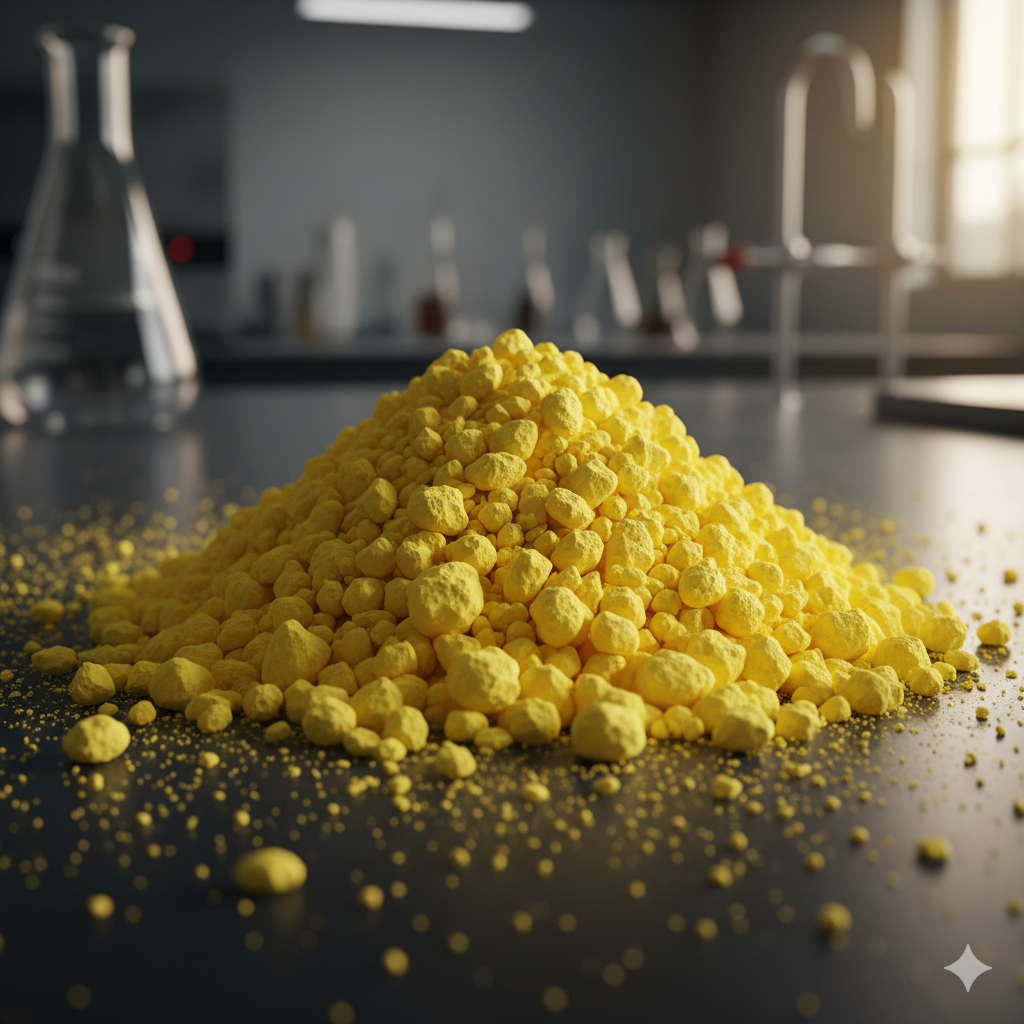
Sulphur is a bright yellow chemical element recognized for its distinctive odor and exceptional industrial significance. Far beyond being a basic raw material, sulphur serves as a foundational input for numerous modern industries, ranging from agriculture and chemicals to petrochemicals and pharmaceuticals.
Before procuring sulphur in bulk, buyers often seek a clear understanding of its technical specifications—especially purity, form, and grade—as these parameters directly influence performance, safety, regulatory compliance, and cost efficiency. This is why search terms such as “Sulphur 99.5% specification,” “lump vs granular sulphur,” and “sulphur purity standards” are so common. Industrial users need certainty that the product they source aligns precisely with their application requirements.
Sulphur is a primary raw material in the production of sulphuric acid, one of the most widely manufactured industrial chemicals worldwide. It is also indispensable in fertilizers, rubber vulcanization, mining, explosives, pharmaceuticals, and multiple chemical synthesis processes.
Even minor variations in sulphur purity or physical form can significantly affect process efficiency, product quality, and operational safety. For example, industrial-grade sulphur is unsuitable for pharmaceutical use, while selecting the wrong physical form—such as dust instead of granular sulphur—can lead to handling issues, inefficiencies, or safety hazards.
Sulphur plays a vital role across diverse sectors:
Agriculture: Used as a soil conditioner and fungicide, sulphur improves soil pH balance and helps protect crops from fungal diseases.
Oil & Gas: Recovered as a by-product during refining and used in gas sweetening and downstream processing.
Chemical Manufacturing: Essential for producing sulphuric acid, carbon disulfide, and other industrial chemicals.
Pharmaceuticals: Utilized in dermatological treatments, ointments, and medicinal formulations.
Mining & Metallurgy: Applied in ore processing, metal extraction, and flotation processes.
Understanding these applications highlights why accurate sulphur specifications are non-negotiable for industrial buyers.
When buyers refer to “Sulphur 99.5% specification,” they are typically referencing the industry benchmark for most industrial applications. But what does this purity level actually represent?
Sulphur purity reflects the percentage of elemental sulphur present in the product. A 99.5% purity level indicates that 99.5 grams out of every 100 grams consist of elemental sulphur, with the remaining portion comprising moisture, ash, or trace impurities.
While the numerical difference between 99.5% and 99.9% may appear minimal, its impact varies significantly by application:
99.5% Purity: Suitable for fertilizers, sulphuric acid production, mining, and general industrial use.
99.9% and Above: Required for pharmaceuticals, food-related applications, and high-precision chemical processes.
Global sulphur trade is governed by strict quality and safety frameworks, including:
ASTM Standards: Define testing methods for sulphur purity and physical properties.
ISO Standards: Ensure consistency and quality in international supply chains.
REACH Compliance (EU): Regulates chemical safety, handling, and environmental impact.
Compliance with these standards ensures sulphur is not only effective but also legally marketable across global regions.
Sulphur is available in multiple grades, each tailored to specific applications:
Technical Grade Sulphur: Used in chemical manufacturing, metal processing, and industrial applications, typically at 99.5% purity.
Agricultural Grade Sulphur: Designed for soil application and crop protection, where particle size and solubility are critical.
These grades meet the highest purity standards (99.9%+) and are rigorously tested for heavy metals, microbial contamination, and trace impurities. Due to health implications, they require extensive regulatory approvals.
Typically ranging between 99% and 99.5% purity, this grade is widely used in rubber processing, pulp and paper, explosives, and heavy manufacturing.
Sulphur’s physical form significantly affects storage, handling, and application:
Lump Sulphur: Large solid blocks, ideal for further processing in industrial facilities.
Granular Sulphur: Uniform particles that flow easily, widely used in agriculture and automated systems.
Prilled Sulphur: Smaller, consistent particles suited for controlled applications.
Pelletized Sulphur: Compacted particles used mainly for soil amendment.
Sulphur Dust: Fine powder offering rapid absorption but requiring careful handling due to flammability.
| Application | Recommended Form |
|---|---|
| Fertilizer Production | Granular |
| Sulphuric Acid Manufacturing | Lump |
| Soil Amendment | Pellet or Dust |
| Pesticide Formulations | Dust |
While lump sulphur is generally more economical to produce, granular sulphur offers advantages in handling efficiency, reduced wastage, and safer logistics.
A comprehensive sulphur specification sheet should include:
Purity (%)
Moisture Content
Ash Content
Acidity (as H₂SO₄)
Carbon Residue
Particle Size Distribution
Color and Odor
Each parameter directly impacts product performance, storage stability, and compatibility with industrial processes.
Major sulphur-exporting regions include Saudi Arabia, UAE, Russia, Canada, and the USA, with sulphur primarily recovered from oil and gas refining. Import demand remains strong in India, China, Brazil, and South Africa, driven by fertilizer and chemical industries.
The source, logistics method, and storage conditions all influence final product quality, making supplier transparency essential.
Sulphur must be stored in dry, well-ventilated areas, away from ignition sources. Dust control, explosion-proof equipment, and proper PPE are critical for safe handling. Compliance with MSDS guidelines and environmental regulations minimizes operational and legal risks.
Reliable sulphur suppliers provide:
ISO-certified quality systems
REACH compliance
SGS / Intertek / Bureau Veritas test reports
Consistent batch traceability
Third-party testing validates supplier claims and protects buyers from quality disputes.
Sulphur may appear simple, but its purity, form, grade, and specifications determine its true industrial value. Choosing the correct sulphur ensures process efficiency, safety, regulatory compliance, and long-term operational success.
For industrial buyers, informed decision-making and transparent suppliers are essential. The right sulphur—backed by data, certification, and consistency—protects both your production process and your reputation.
Copyrights © 2024 All Rights Reserved by EMIRACHEM. Developed by -.